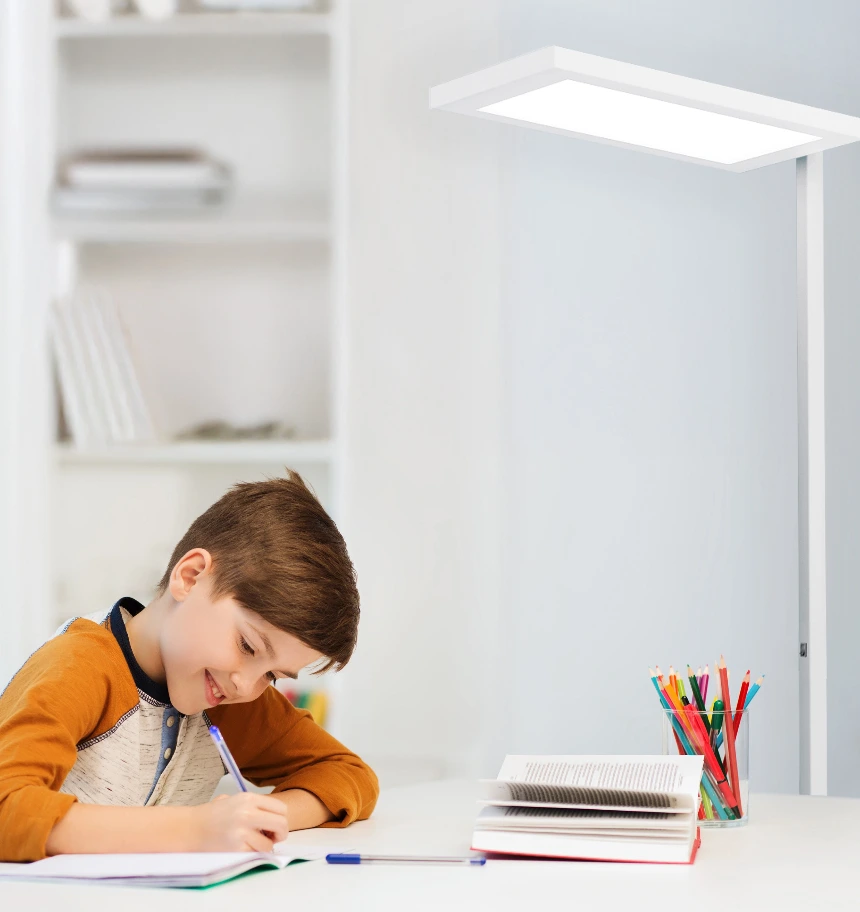
Ask any teenager working late into the evening how their eyes feel after two hours of studying, and you will hear the same complaints: burning eyes, dry vision, tension headaches, and a sudden drop in concentration.
While parents often attribute this fatigue to screen time or lack of sleep, eye care professionals point to another culprit: poor desk lighting. Standard directional desk lamps create intense visual contrast that strains developing eyes. Here is why parents are moving away from traditional desk lights and adopting a modern floor study lamp for home study spaces.
The Hidden Science of Pupil Exhaustion
Human eyes were designed to work under the broad, indirect illumination of natural sunlight. When a student sits in a dark room under a standard desk lamp, two conflicting visual environments are created simultaneously:
- The Bright Desk Zone: A high-intensity spotlight reflecting off paper.
- The Dark Peripheral Zone: The pitch-black ambient room surrounding the desk.
Every time a student looks up from their notebook to think, scan the room, or look at a textbook, their pupils must instantly dilate to handle the dark room, then rapidly contract when returning to the bright desk. Doing this hundreds of times per hour exhausts the eye muscles, leading to heavy eyelids and loss of focus.
How Dual-Direction Illumination Eliminates Eye Strain
To create the best study light environment, lighting engineers use a concept called Direct/Indirect Light Distribution. Rather than forcing a single bulb to do all the work, an advanced floor study lamp divides the light engine into two distinct layers:
- The Ambient Ceiling Cloud (Indirect Light): Projects approximately 80% of the light upward against the ceiling. This bounces a wide, soft layer of illumination back down across the entire room, eliminating dark corners and harsh shadows.
- The Task Light Matrix (Direct Light): Delivers precise, flicker-free light downward directly onto the desk surface for reading and writing.
By combining these two layers, the contrast between the desk and the room drops to near zero. A student’s pupils remain relaxed, allowing them to focus on learning rather than fighting visual strain.
Key Advantages of an Ergonomic Floor Lamp Setup
Beyond eye health, switching to a dedicated floor study lamp provides several immediate practical benefits for a home study space:
- Zero Desk Footprint: Clamped or freestanding floor units sit beside the desk, freeing up 100% of the desk surface for notebooks, laptops, and textbooks.
- Shadow-Free Writing: Precision-engineered LED arrays spread light across wide angles, preventing a student’s writing hand from casting distracting dark shadows on the page.
- Future-Proof Investment: Built with durable commercial-grade materials, a high-quality floor unit lasts from middle school all the way through college and graduate studies.
Creating the Ultimate Home Study Environment
If your student is struggling to stay focused during late-night study sessions, take a close look at their lighting setup. Replacing harsh, single-point desk lights with an indirect floor study lamp creates a calm, glare-free workspace where eyes stay relaxed and deep focus comes naturally.