Key Takeaway
Late-night study fatigue and irritability aren’t always a discipline problem. Standard consumer desk lamps produce an invisible “micro-flicker” and high-contrast hotspots that force the eye muscles into an exhaustive workout. Eliminating this hidden biological friction with flicker-free, balanced lighting is the easiest way to protect a child’s evening focus.
It happens at almost the exact same time every night. The focus shatters. The posture slumps. A routine math assignment turns into an emotional battleground of irritability, sighs, and heavy blinking.
Most parents chalk it up to a short attention span, burnout from a long school day, or a simple lack of academic discipline. So, you step in with a pep talk, a snack, or a strict “no screens” rule.
But you might be fighting the wrong enemy.
The real culprit behind that sudden drop in cognitive endurance is often sitting right on their desk, hidden in plain sight. It’s “visual fatigue”—a literal neurological drain triggered by standard consumer lighting.
The Invisible Pulse Draining Their Brain
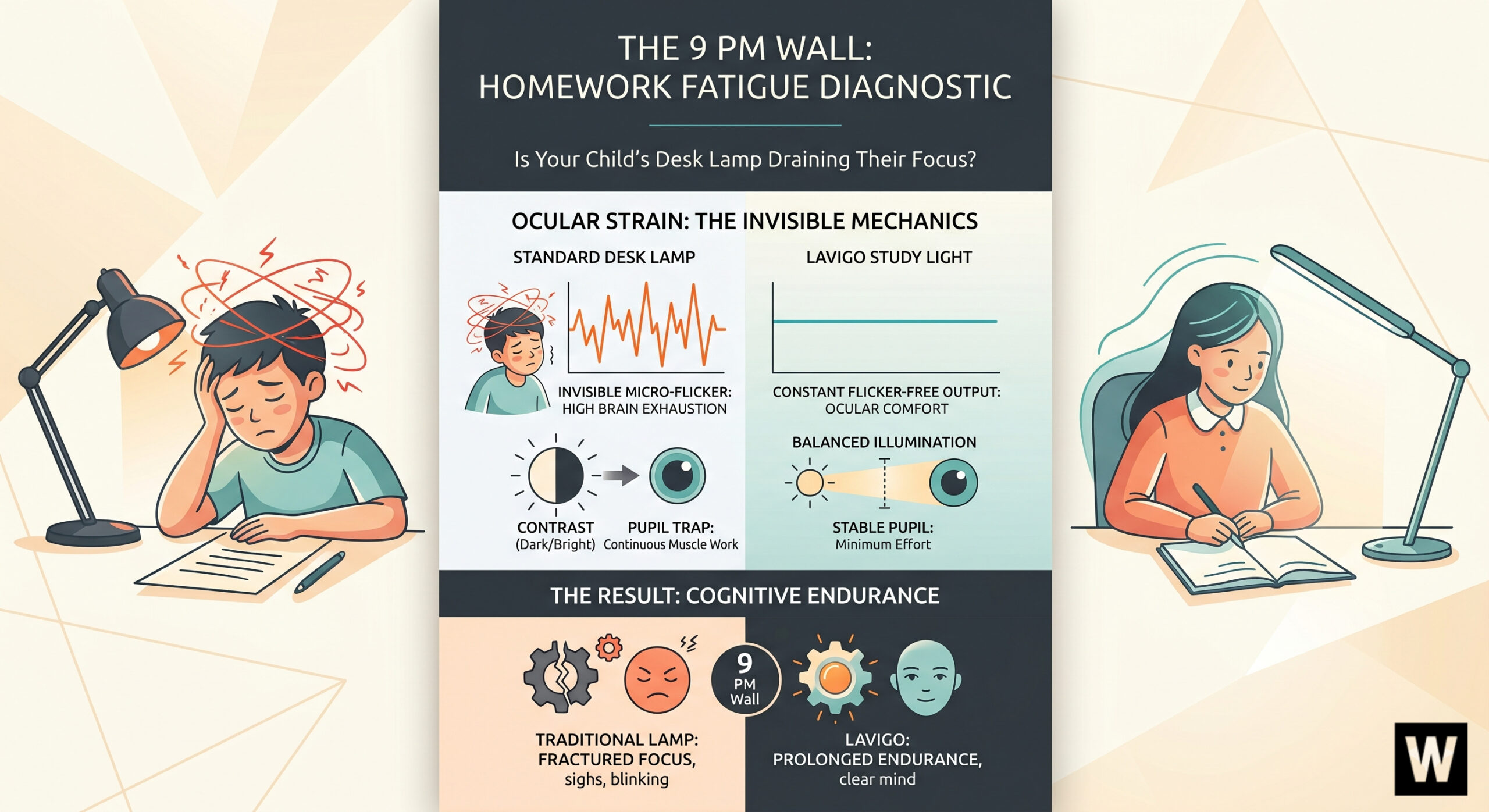
Look closely at a standard LED desk lamp. To the naked eye, it looks perfectly steady. But underneath that static glow is a cheap ballast causing the light to pulse. This is micro-flicker. It happens hundreds of times per second.
While your conscious brain can’t see it, your retina can.
Your pupils are forced to micro-adjust to these rapid changes in light intensity thousands of times per hour. It is the physiological equivalent of making your child’s eye muscles do an intense weight-lifting workout while they are trying to comprehend calculus. The brain works overtime to process the unstable visual input. The result? Headaches, mental exhaustion, and that classic 9 PM wall.
The High-Contrast Pupil Trap
Then there is the structural layout of a typical desk lamp. A standard lamp casts a harsh, concentrated “hot spot” directly onto the notebook or laptop screen, leaving the rest of the bedroom in deep shadow.
Every single time your child glances up from their page to look across the room—or even just to the edge of their keyboard—their pupils must rapidly dilate to adjust to the dark, and then instantly contract when they look back down.
This constant back-and-forth pumping mechanism physically drains their mental energy. They aren’t losing focus because they don’t care about the grade. They are losing focus because their eyes are exhausted.
Designing a Frictionless Workspace
To fix homework fatigue, you have to fix the light delivery. True academic endurance requires volumetric, stable illumination. The light needs to be entirely flicker-free at a biological level, and it must balance the room’s ambient space so the eyes never have to fight high-contrast shadows.
When you eliminate the invisible physical friction in their study environment, the mental friction usually disappears with it.