Key Takeaway
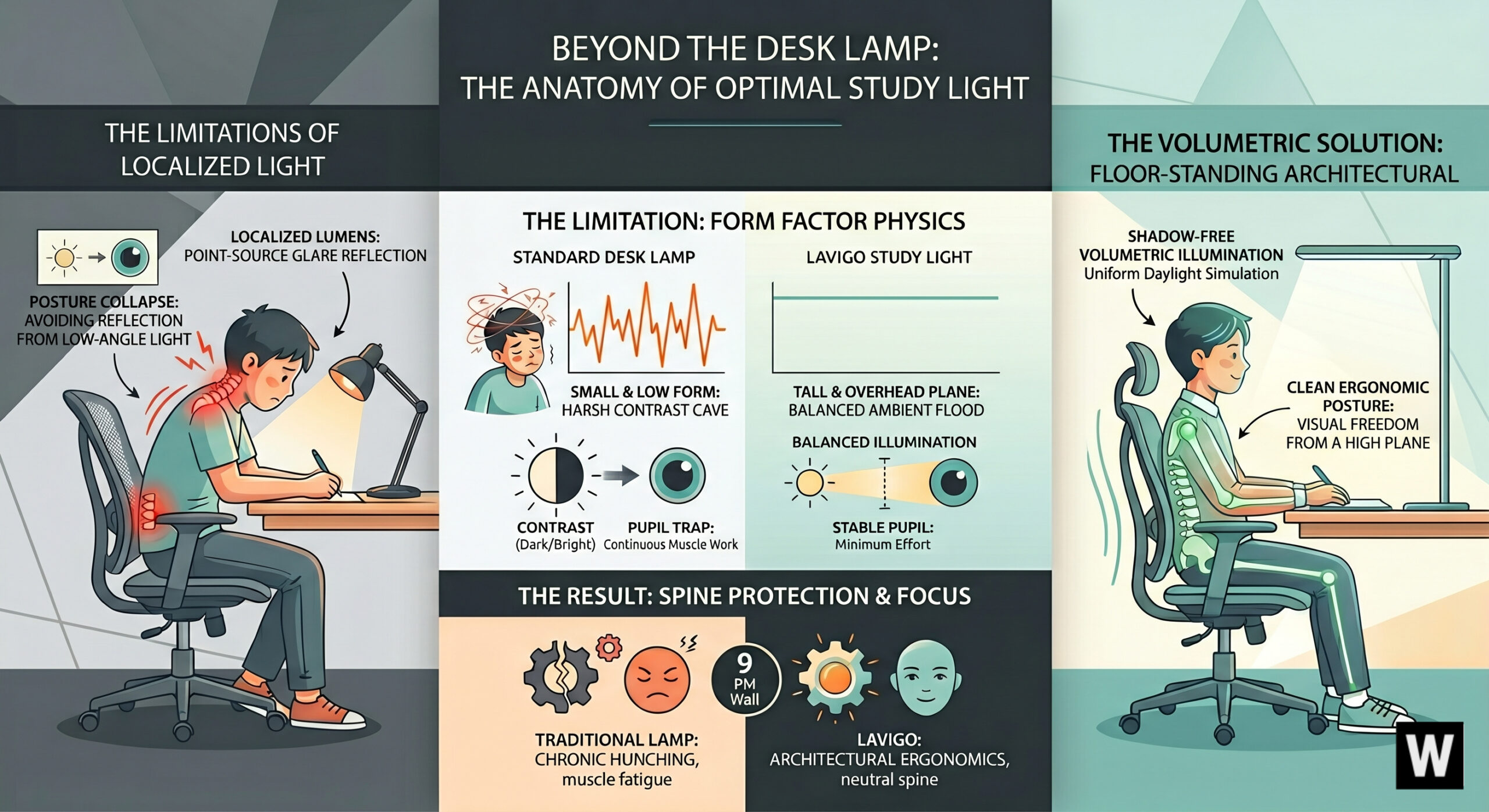
Traditional desk lamps are an evolutionary dead end for serious study spaces. Because they sit low and to the side, they create harsh paper glare that forces students to slouch or hunch over to see clearly. Shifting to an elevated, floor-standing architectural setup removes the glare entirely—protecting both spinal alignment and visual clarity.
When parents build a premium study environment for a high-achieving student, they follow a familiar checklist. They secure a quiet room. They buy an ergonomic mesh chair. They purchase a lightning-fast laptop.
Then, they finish the setup by clamping a tiny, $40 plastic desk lamp to the corner of the workspace.
It is a massive architectural blind spot. We treat lighting like an afterthought—a quick utility piece just to ensure the text is readable. But traditional desk lamps, even the expensive “smart” ones, are fundamentally limited by their form factor. They are too small, too low, and entirely localized.
Serious academic focus requires a shift away from the desk lamp altogether. The future of high-performing study spaces belongs to floor-standing, architectural illumination. Here is why.
The Problem with Localized Lumens
A standard desk lamp is a point-source light. It shoots illumination from a single, low angle close to the work surface. This creates an immediate physical problem: extreme glare reflections off white paper and laptop screens.
To avoid the glare, students instinctively adjust their posture—hunching forward, tilting their heads, or leaning away from the light source. You bought them a $600 ergonomic chair to protect their spine, but the physics of their cheap desk lamp is actively forcing them into a terrible, slouching posture anyway.
The Volumetric Alternative
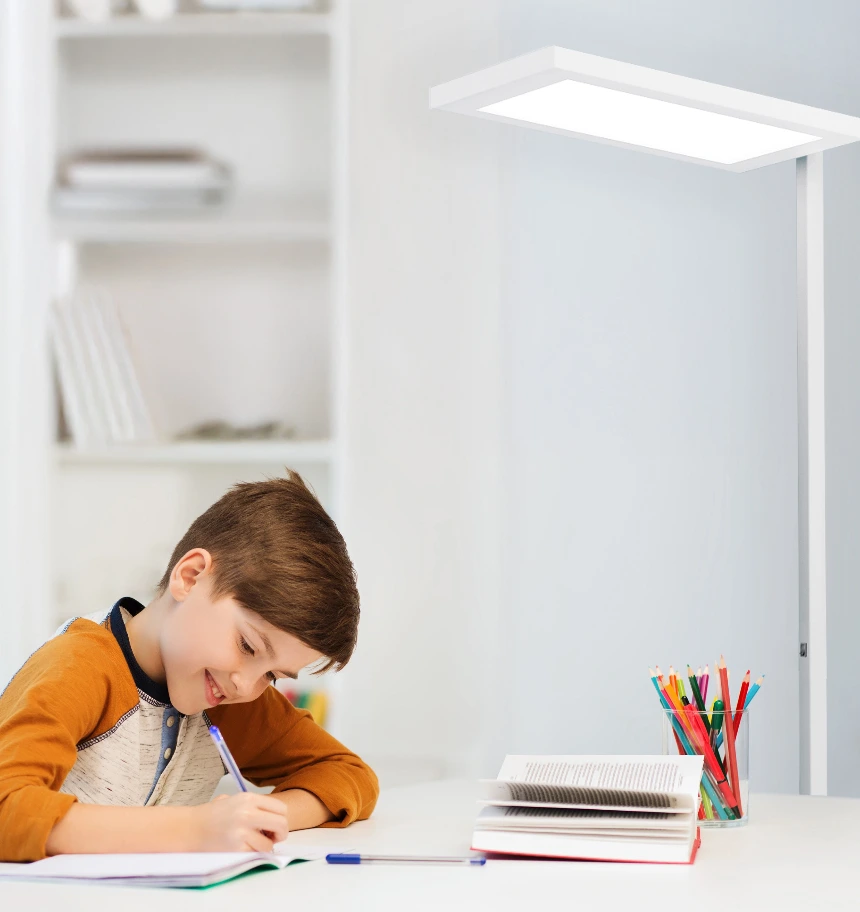
Floor-standing architectural lighting solves this by changing where the light originates. Instead of sitting on the desk surface and taking up valuable real estate, a floor-standing luminaire stands tall, casting light from high above the workspace.
This allows the light to do two things simultaneously:
- Direct Lighting: It casts a wide, perfectly uniform downward beam that covers the entire desk, not just a small circle.
- Indirect Lighting: It throws light upward against the ceiling, bouncing a soft, natural ambient glow throughout the entire room.
Medical-Grade Precision at Home
By balancing the direct and indirect light, you mimic natural daylight. There are no harsh shadows, no localized hot spots, and no screen glare. The eyes stay relaxed because the environment feels open, open-air, and organic—not like a dark cave with a spotlight pointed at their face.
If you are designing a space meant for hours of deep, uninterrupted cognitive work, stop looking at accessories that sit on the desk. Look at architectural solutions that control the entire room.